The DevOps Scaling Problem Nobody Talks About
Picture this: a senior engineer joins a fast-growing startup. She’s talented, experienced, and ready to ship. But on Day 1, she spends two full days figuring out which Kubernetes cluster to target. She opens a ticket for database provisioning — it sits for three days. She copies a CI/CD pipeline from another team’s repo and spends another day debugging namespace permissions. By end of Week 2, she hasn’t written a single line of business logic.
This isn’t a talent problem. It’s a platform problem — and it’s playing out in thousands of engineering teams right now.
DevOps was a cultural revolution: break silos, automate delivery, share ownership. For years it worked. But as organizations scaled — dozens of microservices, multiple clouds, hundreds of engineers — the DevOps model started producing the very friction it was designed to eliminate. Shared responsibility became unclear responsibility. Tooling diverged. Knowledge fragmented. Every team reinvented the same pipelines.
“In 2026, the complexity of the cloud-native ecosystem has reached a breaking point for many engineering teams. Developers spend more time fighting the infrastructure than writing business-critical code.”
What Is Platform Engineering, Really?
Platform Engineering is the discipline of building and maintaining Internal Developer Platforms (IDPs) — paved roads that give developers self-service access to the infrastructure, CI/CD, security, and observability capabilities they need, without requiring them to become Kubernetes or Terraform experts.
It doesn’t replace DevOps. It evolves from it. Where DevOps said “you build it, you run it,” Platform Engineering says “here’s a well-lit path to build and run it — safely, consistently, and at scale.”
Golden Paths
Pre-approved, opinionated templates for common tasks — from spinning up a microservice to provisioning a database. The right way becomes the easy way.
Developer Portal
A unified interface (usually Backstage) where developers discover services, access docs, deploy, and observe — without filing tickets.
Built-in Security
Compliance, policy-as-code, and security guardrails embedded at provisioning time — not bolted on after the fact.
Platform as a Product
The platform team treats developers as customers. Features are prioritized by developer impact. NPS scores drive roadmaps.
The key philosophical shift: Infrastructure is a product, not a ticket queue. Platform teams build APIs and abstractions that turn days of setup into minutes of self-service.
The Numbers Driving This Shift
This isn’t just hype. The data is unambiguous:
Real-world result: Toyota’s (TMNA) platform team reduced environment spin-up from months to 6 hours. One team saved 6 weeks of effort — approximately $250,000 in engineering cost.
But here’s Gartner’s caveat that few people read: “80% will have platform teams, but fewer than 30% will achieve measurable developer productivity gains.” The gap between “we have a platform team” and “our platform genuinely accelerates engineering” is where most organizations live in 2026 — spending $500K–2M annually on IDPs that developers ignore.
The rest of this article shows you how to be in the winning 30%.
DevOps vs. Platform Engineering: Key Differences
| Dimension | Traditional DevOps | Platform Engineering |
|---|---|---|
| Ownership model | Shared (you build it, you run it) | Platform team owns infrastructure abstraction; devs own apps |
| Developer experience | Full infrastructure knowledge required | Self-service golden paths, minimal infra knowledge needed |
| Tooling | Point tools (Jenkins, Terraform, Helm…) | Unified IDP with integrated CI/CD, security, observability |
| Security/Compliance | Shift-left (added to pipelines) | Built-in at provisioning layer, policy-as-code by default |
| Scaling | Struggles with 50+ services / 100+ engineers | Designed for large-scale, multi-team environments |
| Feedback loop | Team retrospectives | Developer NPS, platform adoption metrics, DORA |
| Mindset | Cultural / collaborative | Product engineering (platform = product) |
The bottom line: DevOps gives teams freedom. Platform Engineering gives teams freedom that actually scales. One isn’t better — they’re sequential. You need DevOps culture before you can build a successful platform on top of it.
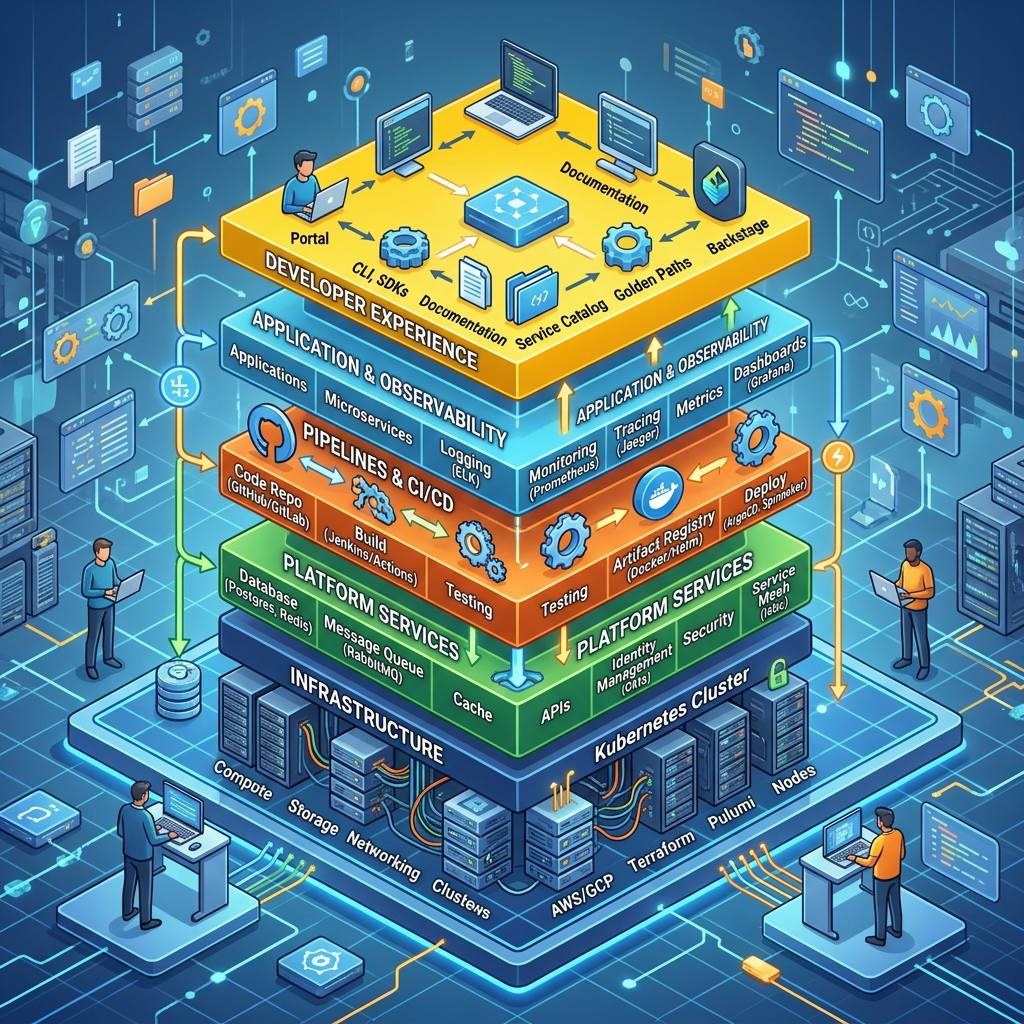
Architecture of a Modern IDP
A well-built Internal Developer Platform is a layered system. Each layer abstracts complexity from the layer above it. Here’s what the reference architecture looks like in 2026:
The beauty of this model is that each layer is independently replaceable. You can swap out your CI/CD tooling in Layer 2 without changing what developers see in Layer 1. You can migrate from one cloud provider to another in Layer 4 without disrupting platform services above it. This loose coupling is what enables genuine platform evolution over time.
Building with Backstage: A Hands-On Example
Backstage — originally built by Spotify, now a CNCF project with over 270 public adopters including LinkedIn, Vodafone, and CVS Health — holds approximately 89% market share among organizations that have adopted a developer portal. Here’s how a real Golden Path template looks in Backstage’s scaffolder:
# template.yaml — Golden Path: Create a New MicroserviceapiVersion: scaffolder.backstage.io/v1beta3kind: Templatemetadata: name: microservice-golden-path title: New Microservice (Golden Path) description: Production-ready service with CI/CD, K8s, monitoring & secrets tags: [golden-path, kubernetes, nodejs]spec: owner: platform-team type: service parameters: - title: Service Details properties: serviceName: title: Service Name type: string pattern: '^[a-z][a-z0-9-]*$' team: title: Owning Team type: string ui:field: OwnerPicker language: title: Language / Framework type: string enum: [nodejs, python, go, java] default: nodejs steps: - id: fetch-base name: Fetch base template action: fetch:template input: url: ./skeleton/${{ parameters.language }} - id: publish name: Create GitHub repository action: publish:github input: repoUrl: github.com?owner=myorg&repo=${{ parameters.serviceName }} defaultBranch: main requireCodeOwnerReviews: true - id: register name: Register in Backstage catalog action: catalog:register input: repoContentsUrl: ${{ steps.publish.output.repoContentsUrl }} catalogInfoPath: /catalog-info.yaml - id: provision-vault name: Provision secrets namespace in Vault action: http:backstage:request input: method: POST path: /api/vault-provisioner/namespace body: service: ${{ parameters.serviceName }} team: ${{ parameters.team }} output: links: - title: Open Repository url: ${{ steps.publish.output.remoteUrl }} - title: View in Catalog url: ${{ steps.register.output.catalogInfoUrl }}
When a developer runs this template, Backstage automatically creates the repo, configures the CI pipeline, provisions Vault secrets, and registers the service in the catalog — all in under three minutes, with zero ops tickets.
Now let’s look at a sample catalog-info.yaml that the template drops into the new repo — this is what makes the service discoverable and observable across the entire engineering org:
apiVersion: backstage.io/v1alpha1kind: Componentmetadata: name: payment-processor description: Handles payment authorization and settlement annotations: # Links to observability, CI, and on-call rotation github.com/project-slug: myorg/payment-processor backstage.io/techdocs-ref: dir:. pagerduty.com/service-id: P1A2B3C grafana/dashboard-selector: payment-processor tags: [payments, critical-path, pci-dss]spec: type: service lifecycle: production owner: team-payments system: checkout-platform dependsOn: - component:order-service - resource:payments-db
🧠 Quick Check: Test Your Platform Engineering Instincts
What’s the single biggest mistake teams make when building an Internal Developer Platform?
Essential Tools for Platform Engineering in 2026
You don’t need all of these on day one. But knowing the landscape helps you make deliberate choices rather than accumulating tool sprawl:
⚠️ Tool sprawl is the enemy. A platform built on 20 loosely integrated tools creates more cognitive load than it eliminates. Start with 3–5 tools that cover your biggest pain points. Expand deliberately.
Your 90-Day Platform Engineering Roadmap
Don’t boil the ocean. Here’s a realistic phased approach to getting your first IDP delivering value within a quarter:
🎯 Success metric for Day 90: At least 2 teams using golden paths, deploying new services in under 30 minutes, with zero manual ops tickets for standard workflows.
The Bottom Line
Platform Engineering isn’t a replacement for DevOps culture — it’s DevOps culture made operable at scale. The organizations winning in 2026 aren’t the ones with the most engineers; they’re the ones where every engineer operates at maximum leverage because the platform removes friction, enforces consistency, and enables self-service.
The gap between “having a platform team” and “having a platform that works” is wide. Closing that gap requires treating your IDP like a product — with a roadmap, metrics, customers (your developers), and a relentless focus on removing friction.
Start small. Measure obsessively. Make the golden path genuinely golden. The infrastructure is the product.
Leave a Reply